A retail strip mall in Melbourne with 40,000 square feet of turf and ornamental beds cannot be watered the same way as a half acre HOA common area in Rockledge, FL. Yet that is what happens when property managers pick a commercial irrigation system on price alone, without looking at property type, soil behavior, and local water rules. The result is overwatered turf, drought stressed shrubs, inflated water bills, and eventually a replacement job that costs more than doing it right the first time.
This guide breaks down the main commercial irrigation system types for businesses in Brevard County, matches each type to realistic property categories, and explains the climate, soil, and regulatory factors that make the right choice here different from anywhere else in Florida.
Key Takeaways
- Brevard County’s sandy soils drain quickly, which affects how long each zone should run and which commercial irrigation system type performs best on a given property.
- Rotor heads, pop up spray heads, and drip each suit different parts of a commercial irrigation system, and mixing them on one zone wastes water and causes uneven coverage.
- The St. Johns River Water Management District (SJRWMD) limits when commercial properties can irrigate, so the controller must handle day and time restrictions.
- The EPA WaterSense program reports an average annual water savings of about 15 percent from smart controllers in commercial landscapes, with results varying by site.
- Licensed, insured installation matters because a commercial irrigation system connects to the public water supply and needs backflow protection.
Why a Commercial Irrigation System Needs a Local Plan in Brevard County
Brevard County sits in Florida’s subtropical zone, and two seasons drive every irrigation decision: a wet season from roughly June through October and a dry season from roughly November through May. During the dry months, commercial properties can go weeks without meaningful rain. Turf stress complaints from tenants and HOA residents often peak in February and March, when soil moisture is lowest and browning becomes visible.
The soil makes this harder. Much of coastal Brevard County sits on sandy soil with low organic matter. The University of Florida IFAS Extension notes that the low water holding capacity of Florida soils is what makes irrigation necessary through the dry winter and spring. On sandy lots, water applied too fast or for too long moves below the root zone before the turf can use it. That is not a problem with one spray head or one emitter. It is a scheduling and design problem, and a commercial irrigation system has to be built around it.
Water rules add another layer. Most of Brevard County falls under the SJRWMD, which sets landscape irrigation days and prohibits irrigating between 10 a.m. and 4 p.m. on the standard schedule. A commercial irrigation system without a controller that can handle day of week and time of day limits is a compliance problem from day one.
3 Types of Commercial Irrigation System: What Are Your Options?
Three hardware types cover the vast majority of commercial irrigation system designs in Brevard County. Each has a defined use case, and none of them works well outside it.
Rotor Head Systems
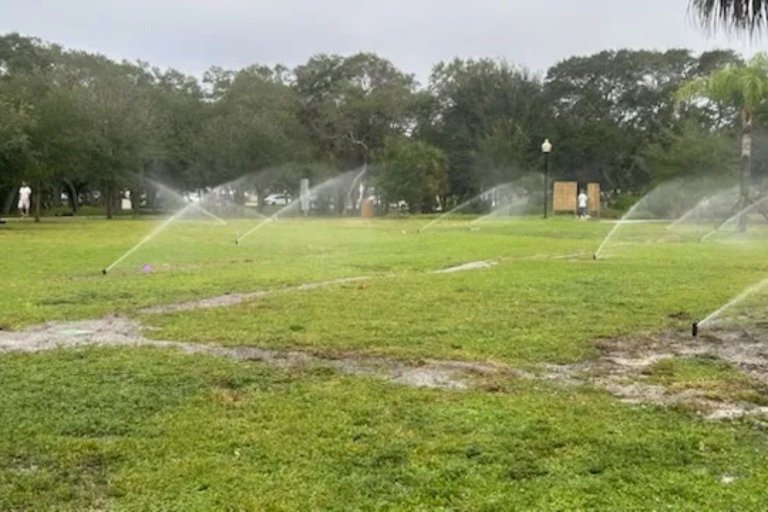
Rotor heads rotate through an arc and throw water roughly 15 to 50 feet, which makes them the right choice for large open turf in a commercial irrigation system: office park lawns, retail center common areas, and sports fields. Their slower application rate, often around 0.4 to 1.0 inches per hour depending on the model, suits fast draining sandy soil better than high output spray heads. The tradeoff is cost, since rotor zones need more pipe, more heads, and more design time to match precipitation rates across irregular shapes.
Pop Up Spray Systems
Fixed pop up spray heads apply water faster, often 1.0 to 2.0 inches per hour, over shorter distances of about 4 to 15 feet. They suit smaller turf panels, median strips, and tight planting areas where a rotor would overthrow onto pavement or buildings. On sandy soil, spray zones need shorter, more frequent cycles to avoid runoff and waste. Placed on the same zone as rotors, they create one of the most common efficiency problems in a commercial irrigation system: one head type drowns an area while the other leaves it dry.
Drip Irrigation
Drip systems deliver water directly to the root zone through low flow emitters, which makes them the most efficient option in a commercial irrigation system for ornamental beds, foundation plantings, and any area where overspray onto pavement, glass, or vehicles is a problem. UF IFAS research on Florida landscapes found that microirrigated beds saved irrigation water compared with sprinkler irrigation, because the low volume output reaches only the planted area. SJRWMD rules also allow drip and micro spray to run outside the restricted watering days and hours, which gives managers more scheduling flexibility.
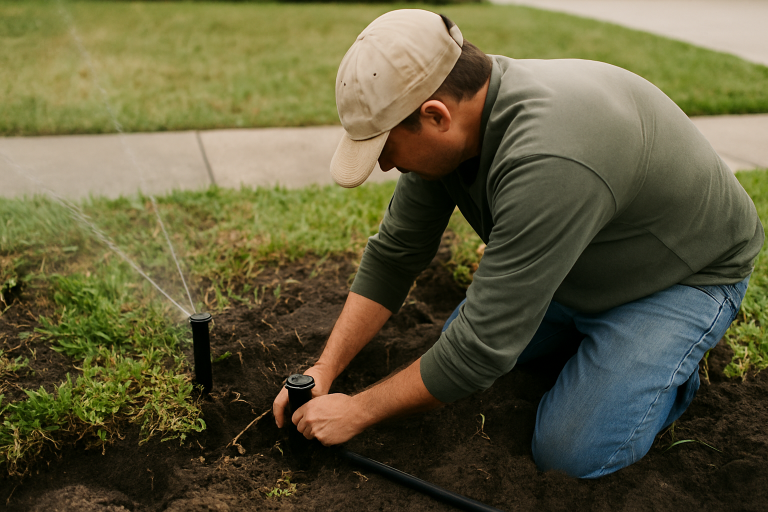
Drip is not maintenance free. Emitters clog, animals chew lines, and mulch depth affects performance. On commercial properties, drip zones should be inspected at least quarterly and flushed each season. A drip irrigation installation and repair service can handle both new bed design and existing zones that have drifted out of spec.
Matching a Commercial Irrigation System to Your Property Type
- Retail strip mall: Rotor heads for large turf panels, pop up spray for medians and entry areas, and drip for foundation beds along the building face.
- Office park: Rotor zones across open lawn, drip in ornamental beds, and a smart controller with weather based scheduling to handle the wet and dry season swing.
- HOA common area: A mix of rotors and spray based on turf panel size, with drip for planted areas near community amenities. HOAs often have stricter appearance standards, so head placement and arc precision matter more.
- Restaurant or retail pad site: Usually small ornamental areas where drip is the main system, with limited turf that needs one or two spray zones.
A commercial irrigation system for a mixed use property often needs more than one hardware type. The commercial irrigation services page shows the kinds of properties and system work a local contractor handles.
4 Factors to Check Before Choosing a Commercial Irrigation System
System type is only part of the decision. Four other factors decide whether the right hardware performs on your property.
Water source and pressure. Municipal pressure commonly runs from about 40 to 80 PSI at the meter, while rotor heads usually perform best at roughly 30 to 50 PSI at the head, so check the manufacturer’s specifications. If a commercial irrigation system has high static pressure and no regulation, heads mist, coverage turns uneven, and parts wear faster. A licensed contractor should test supply pressure before designing zones.
Zone count and controller capacity. A property with a dozen or more zones needs a controller with the zone capacity and scheduling flexibility that a basic timer lacks. Smart controllers adjust run times using local weather data, and the Florida Automated Weather Network (FAWN), run by UF IFAS, publishes weather data from stations across the state. The EPA WaterSense program reports that smart controllers average about 15 percent annual water savings in commercial landscapes, though results vary by site.
Backflow prevention. A commercial irrigation system connected to a potable water supply needs a backflow preventer to keep irrigation water from flowing back into the public supply. Commercial properties commonly use a reduced pressure zone assembly, and these devices are typically tested by a certified tester on a regular schedule, often yearly. Confirm the requirement with your local water utility, since testing rules are set locally.
Maintenance budget. A well designed commercial irrigation system that is maintained on a regular schedule will outlast a cheaper installation by years. Maintenance plans for a commercial irrigation system that include head adjustments, controller audits, and backflow testing protect the investment. A scheduled irrigation system maintenance visit also catches broken heads and clogged nozzles before they turn into a water bill problem.
Florida Water Rules and Efficiency Standards for a Commercial Irrigation System
The SJRWMD publishes landscape irrigation restrictions for its area. Under the standard schedule, nonresidential properties may irrigate on Tuesday and Friday during Daylight Saving Time and on Tuesday only during Eastern Standard Time, and irrigation is prohibited between 10 a.m. and 4 p.m. New landscaping, drip, and micro spray have their own exceptions. Schedules change when the district declares a water shortage, so check the district’s current watering restrictions page and confirm what applies to your address before programming a controller.
Florida law also requires a rain sensor on automatic lawn sprinkler systems. Under Florida Statute 373.62, a system installed after May 1, 1991 must have a working rain sensor device or switch that overrides the irrigation cycle when enough rain has fallen. A new commercial irrigation system should include one, and an older system without one is out of step with state law.
Many utilities and local governments offer rebates or guidance for efficient commercial irrigation system equipment such as smart controllers and soil moisture sensors. Programs and qualifying equipment change over time, so ask your local utility before buying anything. Installation and permitting rules also vary by city, so ask the contractor which permits and inspections apply in your municipality, and who is responsible for them.
Why Professional Installation Matters for a Commercial Irrigation System in Melbourne, FL
A commercial irrigation system is not a do it yourself project. System complexity, permitting questions, backflow protection, and the financial exposure from water waste or property damage on a commercial lot all point to a licensed, insured contractor. A good installer starts with a property walk and a zone design that accounts for turf and plant areas, soil type, water pressure, and local watering restrictions. That is what separates a system that performs for years from one that causes trouble in its first season.
An inspection before any purchase can also save money. A proper review covers head coverage, controller programming, pressure, backflow device status, and zone separation, so it is clear what works, what wastes water, and what needs updating before any new equipment is recommended. If the plan is a new build, look at how an installer handles irrigation system installation, from design through final inspection, and compare it with the sprinkler system installation process for turf areas.
Commercial Irrigation System FAQs
What type of commercial irrigation system is best for a large commercial lawn in Florida?
Rotor heads are usually the best fit for large open turf in a commercial irrigation system on Florida properties. Their lower application rate suits Brevard County’s sandy, fast draining soil, and their long throw means fewer heads cover more area. Pair them with a smart controller to manage wet and dry season scheduling and stay within SJRWMD day and time limits.
How much water can a smart commercial irrigation system save in Brevard County?
The EPA WaterSense program reports an average annual savings of about 15 percent from smart controllers in commercial landscapes, though results vary by site and by how well the system is maintained. Savings are usually larger on properties that had fixed timers running regardless of rain. Ask your local utility about rebates that may offset part of the controller cost.
Do commercial properties in Brevard County need a permit for irrigation installation?
Often yes, but the rules depend on the city and the scope of work, especially when a commercial irrigation system connects to the potable water supply. Ask the contractor which permits and inspections apply to your property, and confirm who pulls the permit before work starts.
What is the difference between drip irrigation and a sprinkler system for commercial use?
Sprinkler systems distribute water through the air over a coverage area, which suits turf and large open zones. Drip delivers water directly to plant root zones through low flow emitters, which cuts evaporation and overspray. Most commercial properties use both: sprinklers for turf and drip for planted beds.
How often should a commercial irrigation system be inspected in Florida?
A common approach for a commercial irrigation system is at least two inspections a year: one at the start of the dry season in November, and one in February or March to catch heads, emitters, or zones that have drifted out of spec. Backflow preventers are typically tested yearly. Properties with drip zones or high value plantings may add an inspection in the middle of the wet season to check emitters and mulch coverage.
Schedule Your Free Commercial Irrigation Inspection and Estimate
Choosing the right commercial irrigation system for a property in Brevard County starts with understanding what the property needs, not what is cheapest or what a national guide recommends. Irrigation Inc. is licensed and insured, and we offer a free commercial irrigation system inspection and estimate for commercial properties across Melbourne and Brevard County. Our team will assess your current system or planned installation against local soil conditions, SJRWMD restrictions, and your water budget. You can also see where we work on our areas we serve page.
Call us at +1 321-514-0315 or request a free quote online to schedule your inspection.